Sudoku: Master Every Puzzle With Smart Strategies and Logical Thinking
Discover the Exciting World of Sudoku
Sudoku is a popular number puzzle game that challenges players to think logically, recognize patterns, and solve problems through careful reasoning. With simple rules and countless possible puzzles, Sudoku offers an enjoyable experience for beginners and experienced players alike. Whether you want to relax during a short break or improve your problem-solving skills, this classic puzzle provides an engaging way to exercise your mind.
Unlike traditional mathematics games, Sudoku does not require advanced calculations. Instead, success depends on logical deduction, attention to detail, and patience. Every puzzle presents a new challenge, encouraging players to examine the available numbers and discover the correct solution step by step.
Today, Sudoku is available in newspapers, puzzle books, mobile applications, and online platforms. Digital versions make it easier than ever to enjoy a quick game at home, at work, or while traveling.
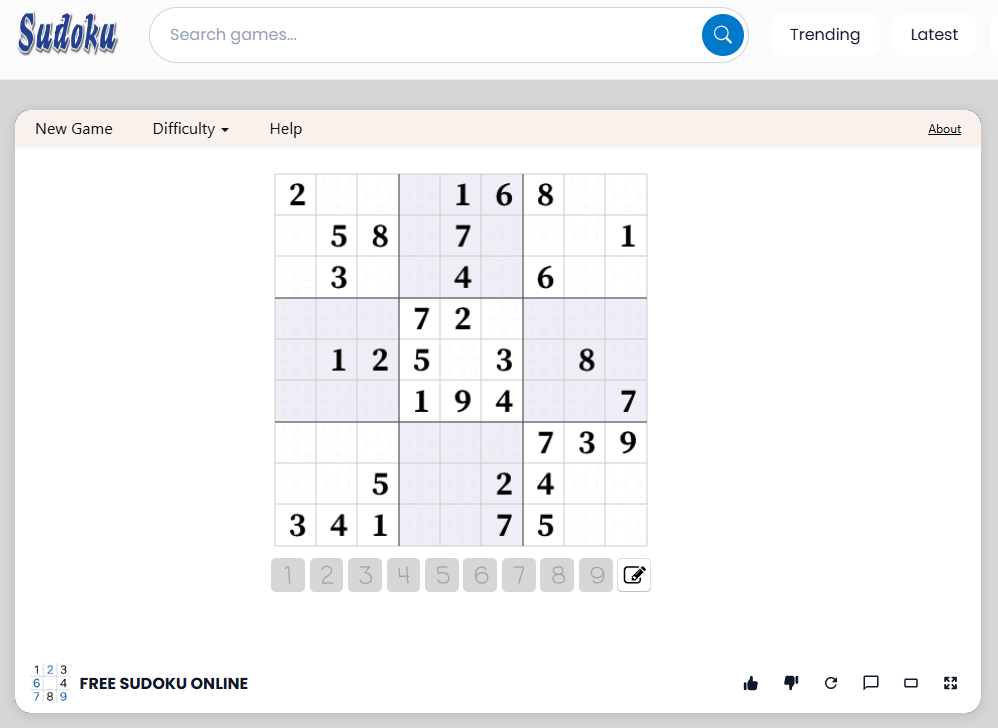
What Is Sudoku and How Does It Work?
Sudoku is a logic-based number puzzle that usually features a nine-by-nine grid divided into nine smaller three-by-three boxes. The objective is to fill every empty cell with a number from 1 to 9 while following a set of simple rules.
Each row must contain every number from 1 to 9 without repetition. The same rule applies to every column and each three-by-three box. Players must consider all three areas before placing a number in an empty cell.
Understand the Basic Rules
The main challenge in Sudoku comes from finding a number that satisfies every restriction at the same time. A number may appear suitable for an empty cell because it is missing from the current row, but it may already exist in the same column or box.
For this reason, players need to examine the surrounding cells carefully before making a decision. The numbers provided at the beginning of the puzzle serve as clues that guide the solving process.
A valid Sudoku puzzle has a logical solution that can be discovered without guessing when the puzzle is properly constructed. Learning to recognize these relationships helps players solve puzzles more confidently.
Explore Different Sudoku Difficulty Levels
Sudoku puzzles are commonly classified into easy, medium, hard, and expert levels. Easy puzzles contain more immediately accessible clues, making them suitable for beginners who are learning the basic rules.
Medium puzzles require additional scanning and more careful consideration of possible numbers. Hard and expert puzzles often demand advanced techniques, including candidate elimination and the identification of relationships between multiple cells.
Choosing an appropriate difficulty level helps players maintain interest while gradually developing stronger logical skills.
How to Play Sudoku Online
Playing Sudoku online provides a convenient way to enjoy number puzzles without needing printed materials. Many platforms offer interactive grids, helpful controls, and multiple difficulty settings.
Start With the Available Clues
Begin by examining the entire grid instead of focusing on a single empty cell. Look for rows, columns, and boxes that already contain many numbers. These areas often provide the easiest opportunities to identify missing values.
For example, if a row contains the numbers 1, 2, 3, 4, 6, 7, 8, and 9, the missing number must be 5. Before entering it, check the corresponding column and three-by-three box to confirm that the placement follows every rule.
Use Notes to Track Possible Numbers
When an empty cell cannot be solved immediately, write down the numbers that could legally fit in that position. These possibilities are known as candidates.
Digital Sudoku games frequently include a notes feature that allows players to record candidates without permanently filling a cell. As other cells are solved, some candidates become impossible and can be removed.
This method makes complicated puzzles easier to manage because it reduces the need to remember every possibility mentally.
Review Each Move Carefully
Accuracy is more important than speed, particularly when learning new techniques. A single incorrect entry can make later decisions confusing and may prevent the puzzle from reaching a valid solution.
Before entering a number, verify the relevant row, column, and box. If the game provides an error-checking feature, use it as a learning aid rather than relying on it to solve every problem.
Effective Strategies to Solve Sudoku Faster
Improving at Sudoku requires more than repeatedly filling empty cells. Successful players develop a systematic approach that helps them identify useful clues and eliminate impossible choices.
Apply the Scanning Technique
Scanning is one of the simplest and most effective Sudoku strategies. Examine a row or column and identify which numbers are missing. Then check the intersecting boxes to determine where each missing number can fit.
For example, if a three-by-three box lacks the number 7, inspect the surrounding rows and columns. Existing sevens may eliminate several cells, leaving only one possible position.
Repeating this process across the grid can reveal multiple placements without requiring complicated calculations.
Identify Naked Singles
A naked single occurs when an empty cell has only one possible candidate. If every other number from 1 to 9 is excluded by the relevant row, column, and box, the remaining candidate must occupy that cell.
This technique is especially useful when a puzzle appears difficult but still contains several opportunities for straightforward deduction.
After placing a naked single, review the surrounding areas again. One confirmed number may eliminate candidates elsewhere and reveal additional solutions.
Recognize Hidden Singles
A hidden single appears when a particular number can fit in only one cell within a row, column, or box, even though that cell contains several possible candidates.
For instance, a row may have several empty cells, but only one position can legally contain the number 4. That position must therefore receive 4.
Learning to identify hidden singles helps players make progress when ordinary scanning no longer produces obvious answers.
Common Sudoku Mistakes to Avoid
One frequent mistake is entering a number because it seems likely rather than because the rules support it. Sudoku rewards logical certainty, so players should avoid making unsupported guesses whenever possible.
Another common problem is overlooking the three-by-three boxes while checking rows and columns. A number can satisfy the first two restrictions but still create a duplicate inside its box.
Players may also become frustrated by spending too much time on one difficult section. When progress stops, move to another row, column, or box. A fresh perspective can reveal a clue that was previously overlooked.
Finally, avoid rushing through a puzzle simply to achieve a faster completion time. Consistent accuracy and a clear solving process are more valuable foundations for long-term improvement.
Benefits of Playing Sudoku Regularly
Sudoku offers an enjoyable opportunity to practice logical reasoning and structured problem-solving. Each puzzle encourages players to compare possibilities, recognize relationships, and make decisions based on available evidence.
Regular play can also provide a focused activity that offers a break from everyday distractions. Concentrating on a puzzle encourages sustained attention and gives players a clear goal to work toward.
Another advantage is accessibility. Sudoku requires no specialized equipment, expensive materials, or advanced mathematical knowledge. Players can choose a quick beginner puzzle or spend more time working through a challenging grid.
Although Sudoku is not a guaranteed method for improving every aspect of memory or intelligence, it provides a practical and entertaining way to exercise logical thinking.
Why Sudoku Remains a Favorite Puzzle Game
Sudoku continues to attract players because it combines simple rules with deep problem-solving possibilities. Every puzzle begins with a familiar grid, yet the arrangement of clues creates a different challenge each time.
Online Sudoku makes the experience even more accessible through convenient controls, adjustable difficulty, and the ability to play across different devices. Beginners can develop essential techniques, while experienced players can explore advanced deductions and challenging puzzles.
The game also offers a satisfying sense of achievement. Each correctly completed section brings the player closer to a full solution, turning a seemingly complicated grid into a series of manageable decisions.
Conclusion
Sudoku is much more than a simple number game. It is an engaging logic puzzle that encourages patience, careful observation, and systematic thinking. By understanding the rules, practicing scanning techniques, identifying single candidates, and avoiding common mistakes, players can steadily improve their solving ability.
Whether you are a beginner discovering your first grid or an experienced player seeking a harder challenge, Sudoku offers an accessible and rewarding experience. Start with a comfortable difficulty level, practice consistently, and enjoy the satisfaction of completing each puzzle through logical reasoning.