Sudoku: A Simple Puzzle That Builds Logic, Focus, and Patience
Sudoku is one of the most popular number puzzles in the world. It looks simple at first, yet every puzzle can provide a challenging mental workout. The game does not require advanced mathematics, special equipment, or previous experience. Instead, Sudoku depends on logical thinking, careful observation, and a methodical approach.
Today, Sudoku appears in newspapers, puzzle books, websites, mobile applications, and educational activities. People of different ages can enjoy the game because difficulty levels can range from beginner to extremely challenging. Understanding the basic rules and useful solving techniques can make Sudoku more enjoyable while also helping players improve their puzzle-solving skills.
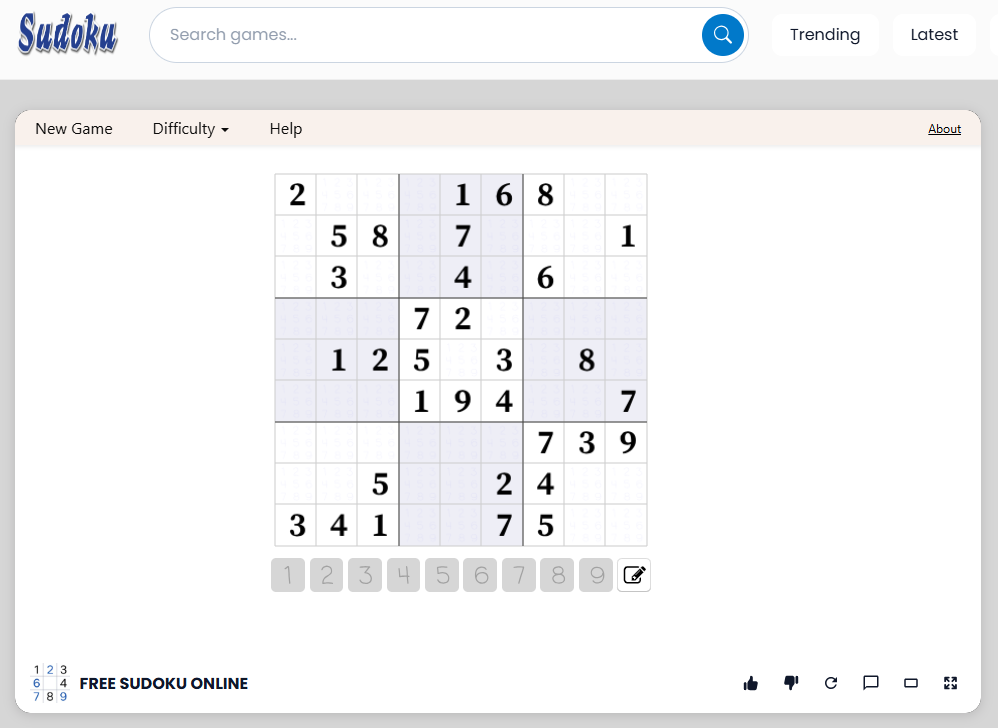
What Is Sudoku?
Sudoku is a logic-based number puzzle based on a 9×9 grid. The complete grid contains 81 cells divided into nine rows, nine columns, and nine smaller 3×3 boxes. Some numbers are provided at the beginning, while the remaining empty cells must be filled by the player.
The main objective is to place numbers from 1 to 9 into the empty cells while following specific rules. Each number must appear exactly once in every row, every column, and every 3×3 box.
Basic Rules of Sudoku
The rules of standard Sudoku are easy to understand. Every row must contain the numbers 1 through 9 without repetition. Every column must also contain the numbers 1 through 9 without repetition. The same requirement applies to each 3×3 box.
A number can only be placed in an empty cell when it does not already appear in the same row, column, or box. These restrictions create a logical structure that allows players to determine the correct position of missing numbers.
Why Sudoku Is a Logic Game
Sudoku is sometimes mistaken for a mathematics game because it uses numbers. However, solving Sudoku does not require calculation. Players do not need to add, subtract, multiply, or divide numbers.
Instead, Sudoku focuses on relationships between cells. Players examine available information, eliminate impossible choices, and identify the only possible number for a particular position. This makes Sudoku an excellent activity for people who enjoy reasoning and problem solving.
How to Start Solving Sudoku
A good solving method begins with the easiest information. Trying to guess numbers randomly can create mistakes and make a puzzle much harder to complete.
Look for Missing Numbers
Start by examining rows, columns, and boxes that already contain many numbers. When only a few cells are empty, it becomes easier to determine which numbers are missing.
For example, if a row contains seven different numbers, only two numbers remain. Checking the related columns and boxes can reveal which number belongs in each empty cell.
Use Candidate Numbers
Candidate numbers are possible values that can fit into an empty cell. To identify candidates, check the numbers already present in the relevant row, column, and 3×3 box.
If a cell can accept only one number, that number becomes a logical placement. Writing small candidate notes can also help players keep track of possibilities during difficult puzzles.
Search for Hidden Singles
A hidden single occurs when a particular number can appear in only one cell within a row, column, or box, even though that cell may have several candidate numbers.
This technique requires more careful observation than simply finding a cell with one candidate. It is especially useful when the puzzle becomes more difficult and obvious placements become less frequent.
Advanced Sudoku Techniques
Once basic techniques become familiar, players can learn advanced methods to solve challenging puzzles without guessing.
Naked Pairs
A naked pair appears when two cells in the same row, column, or box contain exactly the same two candidates. Those two numbers must occupy those two cells, so they can be removed from other cells within the same group.
This technique can reduce the number of possibilities and reveal new placements.
Pointing Pairs
Pointing pairs involve the relationship between a 3×3 box and a row or column. If a particular candidate can appear in only one row inside a box, that candidate cannot appear elsewhere in the same row outside that box.
Recognizing this pattern can significantly reduce candidate numbers.
X-Wing Technique
The X-Wing technique is useful for advanced Sudoku puzzles. It involves finding a number that appears as a candidate in exactly two cells across two different rows, with the candidate occupying the same two columns.
When this pattern forms a rectangle, other occurrences of that candidate can sometimes be eliminated from those columns. X-Wing requires strong visual attention, but it can solve situations that seem impossible with basic techniques.
Benefits of Playing Sudoku
Sudoku provides more than entertainment. Regular puzzle solving can encourage several useful mental habits.
Improves Concentration
A Sudoku puzzle requires sustained attention. Players must remember information, compare multiple cells, and avoid careless mistakes. Regular practice can encourage better concentration during puzzle-solving activities.
Encourages Logical Thinking
Every successful placement should have a logical reason. Players learn to examine evidence, eliminate incorrect possibilities, and reach conclusions based on available information.
Supports Patience
Difficult Sudoku puzzles cannot always be solved quickly. Players may need to revisit the same area several times before discovering an important pattern. This encourages patience and persistence.
Provides Relaxing Entertainment
Sudoku can also be a simple way to spend quiet time away from fast-paced digital activities. The structured nature of the puzzle gives players a clear objective and a focused activity.
Tips for Better Sudoku Results
Improvement comes from developing a consistent solving process. Begin with rows, columns, and boxes that have many completed cells. Avoid placing a number without checking all three restrictions.
Use candidate notes when necessary, but update them whenever a new number is placed. If a puzzle becomes difficult, move to another section instead of repeatedly focusing on one cell.
Most importantly, avoid guessing. A well-designed Sudoku puzzle can be solved through logical deductions. When an answer seems uncertain, continue searching for additional information rather than relying on luck.
Why Sudoku Remains Popular
Sudoku continues to attract players because the basic concept is simple while the possible challenges are almost unlimited. A beginner can understand the rules within minutes, while an experienced player can spend a long time solving an advanced puzzle.
The game also works well in both physical and digital formats. Players can solve Sudoku with a pencil in a puzzle book or use an online Sudoku platform with helpful features such as notes, error detection, timers, and different difficulty levels.
Conclusion
Sudoku is a simple number puzzle built around logic, observation, and careful decision making. The basic rules are easy to learn, but advanced puzzles can provide a serious mental challenge. By starting with missing numbers, using candidate numbers, recognizing singles, and gradually learning advanced techniques, players can become more confident and efficient.
Whether Sudoku is used as casual entertainment, a daily mental exercise, or a competitive challenge, the game offers an accessible way to practice logical thinking. With regular practice and a patient approach, almost anyone can learn to solve Sudoku and enjoy the satisfaction of completing a challenging grid.